
Author: Eveline van Hooijdonk / City of Ghent, Department of Economics and Tourism
Cities across Europe are rethinking the way goods move through their streets. Congestion, emissions, safety challenges, and pressure on public space are pushing urban logistics toward cleaner and more community‑friendly models. In this transition away from a classic van-based delivery model, Ghent’s real-world experiment in the GREEN‑LOG Living Lab Flanders stands out as a powerful demonstration of what sustainable urban logistics can achieve. Rather than theorising about sustainable logistics, Ghent put it directly into practice on its streets, in local shops, and at customers’ doors.
A Pilot designed around everyday reality
From November 2025 to February 2026, Ghent tested a Logistics‑as‑a‑Service (LaaS) platform under fully realistic conditions. Instead of limiting the test to the compact inner city, the pilot deliberately covered the entire municipal area, including the outer districts: an important decision that made the test realistic.
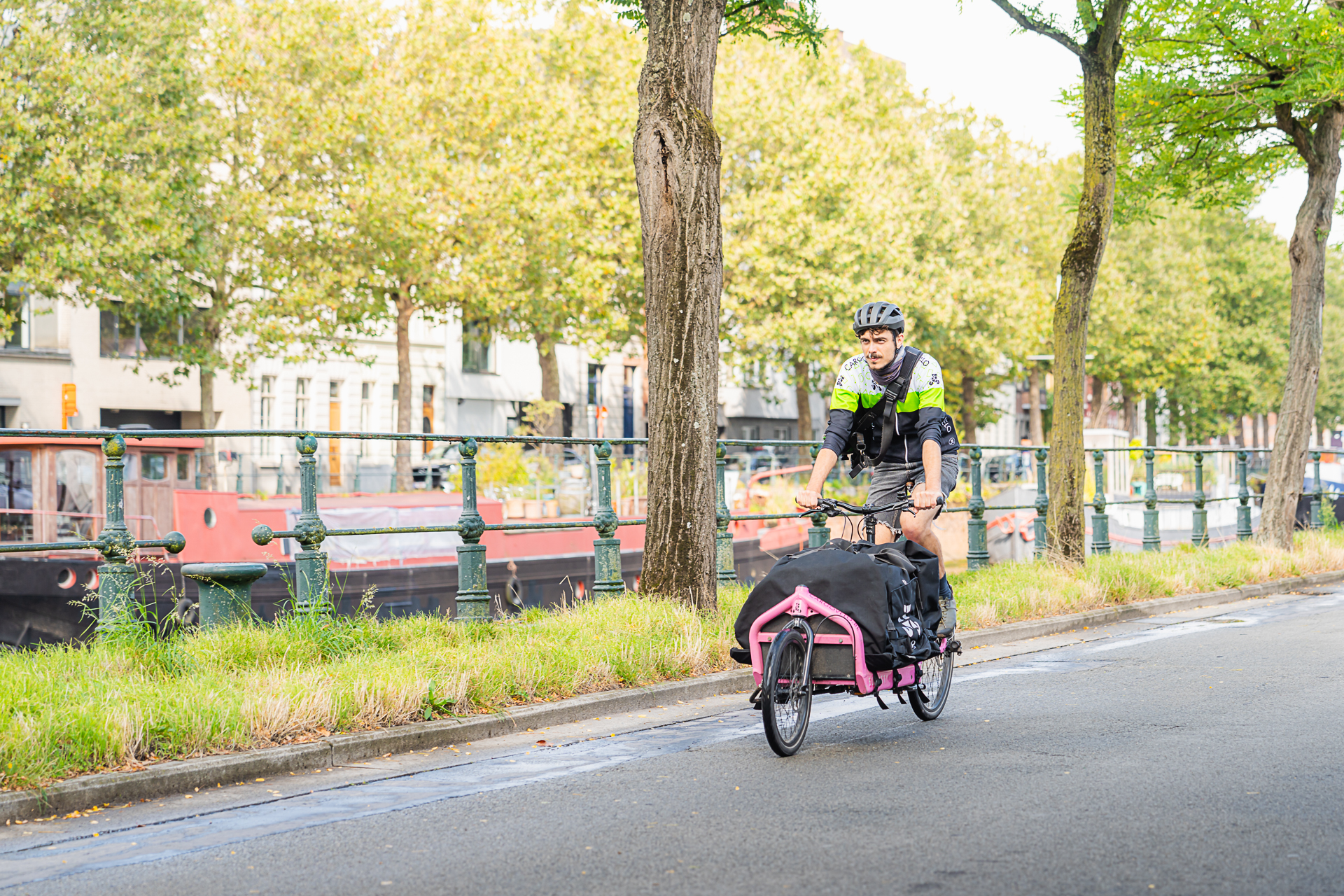
Two local, professional cargo‑bike couriers were contracted to carry out all shipments. These were not staged or simplified test runs: every order was a real shipment created by local shop owner (LSO) for a real customer. Fourteen participating LSOs, ranging from food producers to speciality retailers, used the LaaS platform to book pickups and deliveries under authentic conditions: same‑day requests, varying parcel sizes, and sometimes tight delivery windows. On the platform, LSOs choose a logistic provider, work with a limited monthly delivery budget, and select options from dynamically calculated real‑life prices based on distance, timing, and sustainability choices.
What Happened on the Ground
The couriers completed 271 zero‑emission deliveries. For LSOs, this hands‑on experience was transformative. Many described feeling genuinely unburdened: no more leaving their shops to deliver orders themselves, no more reorganising staff, no more last‑minute van trips.
The couriers became trusted partners. Their personal and professional approach—checking parcels, clarifying uncertainties by phone, ensuring hand‑to‑hand delivery—meant none failed deliveries and higher customer satisfaction. The time saved on logistics allowed LSOs to focus more on their core business.
It’s no surprise that 85% of participating LSOs reported satisfaction with the service’s reliability and professionalism. Many expressed their intention to continue using cargo‑bike couriers beyond the pilot. The test also clearly demonstrated feasibility: the couriers managed a wide range of parcel sizes, weights, and deadlines while maintaining zero‑emission operations.
Visible Environmental and Community Impact
Replacing van deliveries with cargo bikes led to an estimated 180 kg of CO₂ avoided within the limited timeframe of the pilot. While small in isolation, it shows the potential multiplier effect once more LSOs adopt zero‑emission services. These avoided van kilometres also contributed to: lower noise levels, improved air quality and safer streets. Sustainable logistics often focuses on climate goals, but Ghent’s pilot showed that the economic and operational value for businesses is just as strong.
A Clear Path Forward
The Ghent pilot proved that sustainable logistics is not a distant ambition—it’s practical, reliable, and immediately beneficial solution that improves daily life for businesses and residents. The strong satisfaction rate and low failure rate show that more sustainable logistics systems can integrate seamlessly into daily business routines. Ghent offers a real‑world example of the triple win of sustainable logistics: good for the climate, good for cities, and good for the local economy.
Want to know more? Check out: www.stad.gent/greenlog