

Author: Amalia Ntemou / Netcompany SA
One of the main advantages of the Digital Control Tower is its ability to move beyond monitoring and actively support operational decisions.
Through the integration of forecasting services, the platform helps urban logistics operators anticipate changes in parcel demand and traffic conditions before they affect daily operations. By combining historical information with real-time data, the system provides valuable insights that can support more effective resource planning, fleet utilisation, and delivery scheduling.
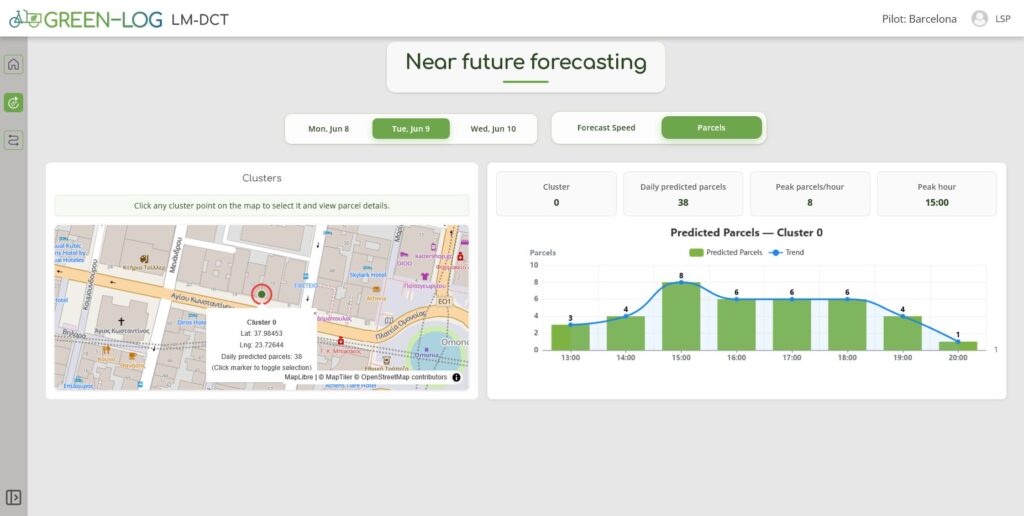
At the same time, dynamic routing capabilities enable delivery plans to be adjusted when disruptions occur. Traffic congestion, access restrictions, failed deliveries, or unexpected demand peaks can all affect operational performance. The Digital Control Tower helps operators respond more effectively to these challenges by providing real-time visibility, updated routing recommendations, and enhanced situational awareness across the delivery network.
This combination of monitoring, forecasting, and optimisation creates a more proactive approach to urban logistics management, helping organisations improve operational efficiency, reduce unnecessary travel, and maintain high service levels even in rapidly changing urban environments.
Supporting Sustainable and Multimodal Deliveries
The GREEN-LOG Digital Control Tower was designed to support a wide range of sustainable logistics concepts that are becoming increasingly important across European cities.
The platform can support delivery operations involving electric vehicles, cargo bikes, consolidation hubs, and multimodal transport solutions. By incorporating vehicle characteristics, operational constraints, and city-specific policy requirements into route planning processes, the system helps stakeholders evaluate different delivery strategies and identify more sustainable alternatives.
A key advantage of the Digital Control Tower is its ability to integrate urban policy objectives directly into logistics operations. Through dedicated policy management functionalities, local authorities can define measures such as low-emission zones, access restrictions, off-peak pick-up and delivery time windows, or incentive schemes. These measures are then reflected in route planning and delivery execution, while also enabling rewards for businesses and receivers who comply with the defined rules.
By linking policy objectives with operational decision-making, the platform helps ensure that sustainability is not treated as an external requirement, but as an integral part of daily logistics planning.
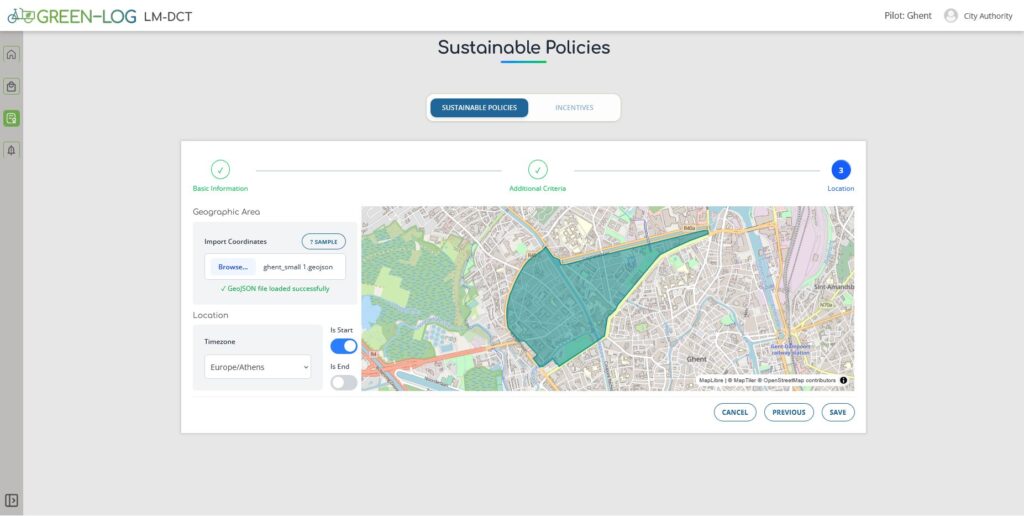
This flexibility was particularly important during the GREEN-LOG demonstrations, where different Living Labs explored innovative delivery models adapted to local needs. From collaborative delivery schemes and consolidation approaches to multimodal transport concepts, the Digital Control Tower provided a common framework for monitoring performance and supporting operational coordination.
By enabling a more integrated approach to logistics planning, the platform helps cities and operators work towards shared environmental and mobility objectives while maintaining efficient service delivery.