Authors: Regina Enrich Sard, Dídac Colominas Abalde / EURECAT
The logistics sector is full of data (delivery routes, vehicle positions, warehouse activity, traffic conditions, energy consumption, delivery schedules) spread among many independent actors such as carriers, city authorities, warehouse operators, mobility providers, retailers, technology companies. Much of this information remains trapped inside isolated systems because companies are often reluctant to share it since data is now considered a strategic asset. The fear of losing control, exposing sensitive operations, or depending on external platforms still limits collaboration across the sector.
This is precisely the challenge addressed by the GREEN-LOG project, an EU-funded initiative that developed a practical City Logistics Dataspace designed for real operational environments.
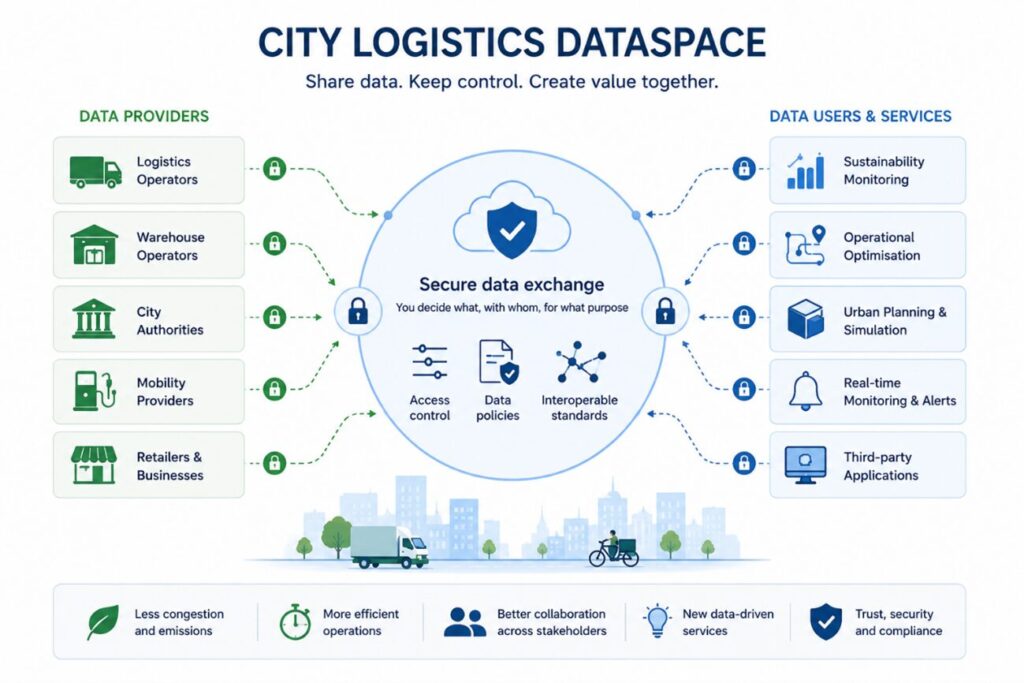
A dataspace can be understood as a secure digital environment where organisations exchange and use data while fully preserving ownership and control. Unlike traditional centralised platforms, participants do not “give away” their information. Instead, they decide exactly what can be shared, with whom, and under which conditions. This concept (known as data sovereignty) is becoming one of the hottest topics in logistics digitalisation. It works as a two-way communication environment: logistics ecosystem actors push data into the dataspace, while other actors and applications retrieve and use it.
In practice, this means that a city authority may access sustainability indicators or aggregated mobility insights, while logistics operators keep commercially sensitive operational data protected. Every participant only sees the information they are authorised to access. The GREEN-LOG dataspace enforces these permissions automatically through secure authentication and role-based access mechanisms, creating a trusted collaboration environment where data remains protected at all times.
What makes the GREEN-LOG approach particularly interesting is that it was not designed only for large corporations with advanced IT departments. The project deliberately considered the reality of urban logistics ecosystems, where many small and medium-sized companies still operate with limited digitalisation. For these organisations, highly complex dataspace architectures can become a barrier instead of an opportunity.
That is why GREEN-LOG adopted a more pragmatic vision. The solution combines advanced European standards and technologies with flexible integration mechanisms that allow organisations to participate progressively, using their existing systems and digital capabilities. In this sense, the project goes beyond the strict theoretical definition of a dataspace and focuses instead on making secure data sharing truly accessible for all actors in the logistics chain.
Behind the scenes, the infrastructure relies on open technologies and European standards that enable interoperability, real-time data exchange, historical analysis, and secure access management. But the real innovation is not technological alone. It is the possibility of creating collaboration without sacrificing independence. In GREEN-LOG it is designed as the digital backbone for advanced logistics services such as prediction systems, optimisation tools, simulation engines, sustainability monitoring, and urban logistics coordination.
Because all services access a common and trusted data environment, decisions become more consistent, reliable, and efficient. This creates opportunities for reducing congestion, lowering emissions, improving delivery efficiency, and enabling better coordination between public and private actors.
As cities search for smarter and more sustainable logistics models, initiatives like GREEN-LOG show that the future of urban logistics may not depend only on who owns the data, but on how securely, intelligently, and collaboratively data can be exchanged and used.
Photo credit: Shutterstock / Open AI generated image